
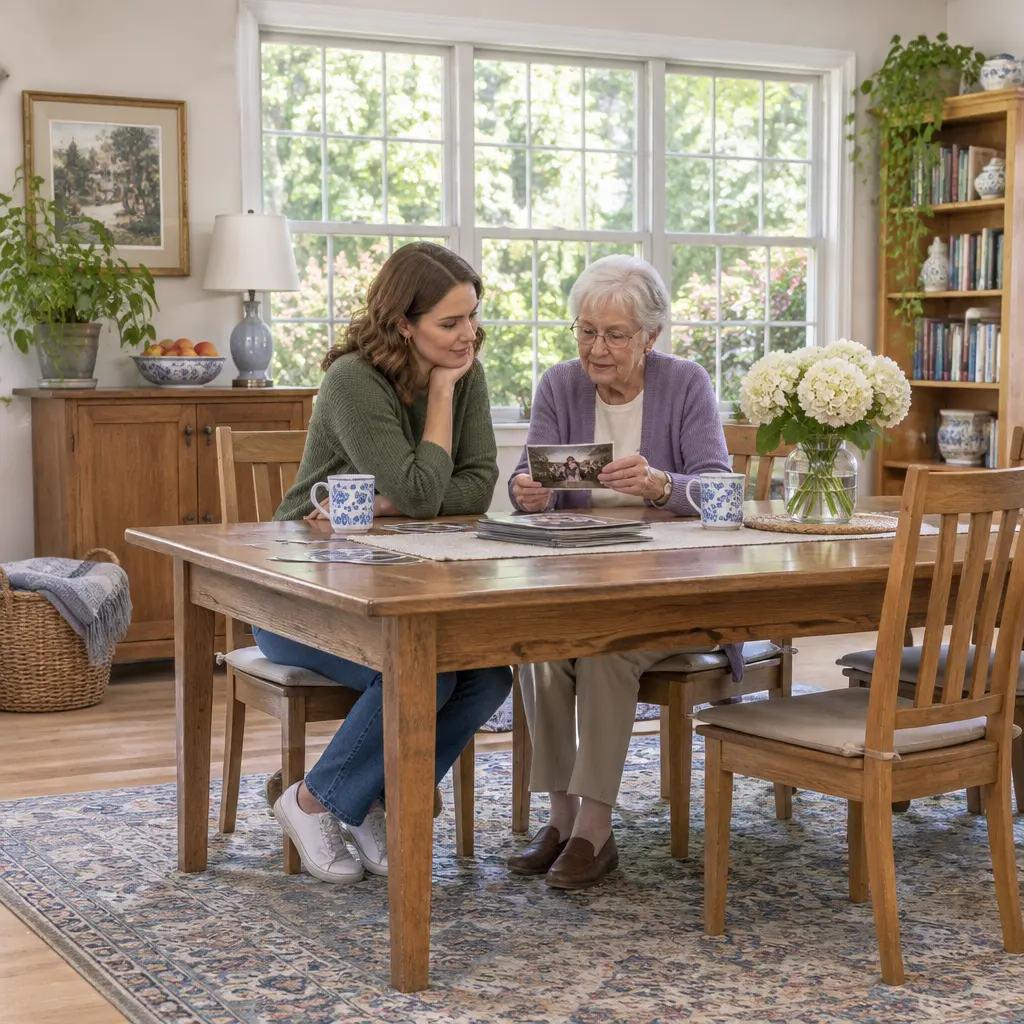
Dementia communication validation is an approach that responds to a person’s feelings and perspective rather than reflexively correcting mistaken details. The Alzheimer’s Association estimates that 7.2 million Americans age 65 and older were living with Alzheimer’s dementia in 2025, underscoring how often families and care workers face difficult conversations. Validation does not mean agreeing with every claim or abandoning safety; it means acknowledging emotion, listening for the need beneath the words, and choosing a respectful response. The sections below distinguish validation from fact-checking, describe practical techniques and limits, and offer examples grounded in dementia-care guidance and research.
Validation-based communication and dementia care
Dementia is a group of conditions that impair cognitive functions such as memory, language, reasoning, or orientation and can affect a person’s ability to communicate. The World Health Organization describes dementia as a syndrome, usually chronic or progressive, involving deterioration in cognitive function beyond what might be expected from typical biological aging. Communication difficulties vary by person and over time, so a response that helps one person may not help another.
Validation-based communication is a person-centered way of responding that recognizes a person’s expressed feelings and treats their experience with dignity, even when the facts they describe appear mistaken. Naomi Feil, who developed Validation Therapy, framed validation as entering the person’s reality and affirming the meaning or emotion behind communication. In everyday care, the term is also used more broadly for techniques such as empathic listening, acknowledging emotion, and avoiding unnecessary arguments. These practices are related, but validation in a brief conversation should not be presented as a proven treatment that reverses dementia or reliably improves cognition.
The distinction matters because correcting a detail does not always address the need driving a conversation. If someone asks repeatedly for a deceased parent, a blunt correction may bring distress without resolving the underlying longing. A caregiver can instead explore what the person is feeling and offer comfort, while remaining truthful when practical decisions or safety require it.
How validation differs from corrective fact-checking
Corrective fact-checking focuses on whether a statement is accurate; validation-focused communication first considers what the statement may mean emotionally or practically. The approaches are not mutually exclusive. A gentle correction can be appropriate when a person asks for information they can use, while repeated correction may be unhelpful when it causes distress and the detail has no immediate consequence.
The National Institute on Aging advises caregivers to communicate clearly, remain patient, avoid arguing, and respond to the feelings behind a person’s words. Alzheimer’s Society guidance similarly recommends not arguing or repeatedly reminding someone of painful information when this is likely to upset them. These are practical care recommendations, not a rule to conceal every fact. The caregiver should consider the person’s preferences, the context, the likely emotional effect, and any safety implications.
Emotional validation
Emotional validation names or acknowledges a feeling without necessarily confirming the factual claim attached to it. For example, if a person says, “I need to go home,” a caregiver might respond, “You’re missing home and want to feel settled. Tell me what you miss most.” This recognizes distress and invites connection without insisting that the current place is or is not home.
The Alzheimer’s Association’s communication guidance emphasizes listening, allowing time for a response, and attending to nonverbal cues. A calm voice, a pause, and an open question may communicate respect more effectively than a detailed explanation. If the person’s words signal pain, fear, or an unmet need, investigate that need rather than assuming the statement is simply a memory error.
Gentle correction and useful truth
Gentle correction is a limited, considerate clarification offered when accurate information is useful and likely to be understood. A caregiver might say, “Your appointment is tomorrow; I’ve written it on the calendar,” then shift to a reassuring activity. This differs from repeatedly testing the person’s memory or demanding that they accept a correction.
Truthfulness remains important in matters involving consent, medical decisions, finances, and immediate safety. If someone is about to leave a safe area, take medication incorrectly, or act on a dangerous misunderstanding, the caregiver should give clear information and take proportionate steps to reduce risk. Where possible, combine the correction with emotional acknowledgment: “You’re worried about being late. Let’s check the appointment card together.”
Redirection and reassurance
Redirection shifts attention toward a comforting or meaningful activity after the caregiver has acknowledged the concern. Reassurance offers calm support without making promises that cannot be kept. For example: “You’re concerned about your mother. You loved spending time with her. Would you like to look at this photo with me?” Whether the person finds this helpful should guide what happens next.
Redirection is not a way to dismiss distress. If agitation is new, persistent, or severe, check for possible causes such as pain, infection, fatigue, hunger, medication effects, sensory problems, or an unfamiliar environment. The person’s clinician can help assess changes in behavior or communication.
Practical validation techniques for everyday conversations
Validation works best as an adaptable set of skills rather than a script. The National Institute on Aging and Alzheimer’s Association recommend reducing distractions, using simple language, allowing extra response time, and showing patience. These steps can make a conversation easier without assuming that every communication difficulty has the same cause.
Listen for the feeling and need
Start by listening to both words and nonverbal signals. Ask yourself whether the person may be communicating loneliness, fear, discomfort, a desire for routine, or a practical need such as using the bathroom. Reflect a possible feeling tentatively—“It sounds like you’re worried”—and give the person room to confirm, correct, or say more.
Use clear, respectful language
Speak at a comfortable pace, use short sentences, and ask one question at a time. Introduce yourself if needed, make eye contact if welcome, and avoid speaking as though the person is not present. Gestures, familiar objects, written reminders, and pictures may help, depending on the person’s abilities and preferences.
Respond to repeated questions without turning the exchange into a test
Repeated questions may reflect anxiety, difficulty retaining new information, or a search for reassurance. Answer calmly, consider whether a visible calendar or note would help, and respond to the emotion as well as the question. Avoid saying, “I already told you,” or quizzing the person to prove they have forgotten.
Adapt to the person and the setting
A familiar routine, quiet space, hearing aids, glasses, and adequate lighting can support communication. Care partners should learn the person’s preferred name, life history, language, cultural expectations, and ways of expressing discomfort. If a technique increases distress, stop and try another approach rather than insisting that the person respond in a particular way.
Evidence, limitations, and safety considerations
Person-centered communication is widely recommended in dementia care, but evidence for specific validation methods is more limited than the popularity of the term may suggest. A Cochrane review of Validation Therapy found the available studies too limited to establish firm conclusions about its effects. This does not show that empathy is useless; it means caregivers and organizations should avoid claiming that validation therapy is a proven cure or that it works uniformly for every person.
A useful outcome is often practical and observable: the person appears more comfortable, communicates a need, or is able to participate in care. Care partners can note what happened before and after a response, including time of day, surroundings, possible discomfort, and which words or activities seemed calming. This can help a family or care team identify patterns without treating a single interaction as proof of effectiveness.
Validation must also be balanced with protection and professional assessment. Do not dismiss reports of pain, abuse, or danger as “just dementia.” Take concerns seriously, seek appropriate help, and document relevant observations. Sudden confusion or a rapid change in behavior warrants prompt medical attention because acute illness or another treatable problem may be involved.
Conclusion: a respectful balance of validation and facts
Validation-based dementia communication prioritizes the person’s feelings and needs; gentle correction supplies useful facts when they matter; and reassurance or redirection can support comfort when correction would only create distress. These approaches should be guided by the individual, the circumstances, and safety—not applied as a rigid formula. With patience, attentive listening, and appropriate clinical support, families and care workers can make everyday conversations more respectful and responsive. For further guidance, consult the National Institute on Aging, the Alzheimer’s Association, and a dementia-informed health professional, and share effective communication approaches with everyone involved in the person’s care.
Sources: World Health Organization, Dementia, https://www.who.int/news-room/fact-sheets/detail/dementia; Alzheimer’s Association, 2025 Alzheimer’s Disease Facts and Figures, https://www.alz.org/alzheimers-dementia/facts-figures; National Institute on Aging, Alzheimer’s Caregiving: Tips for Communicating With a Person With Alzheimer’s Disease, https://www.nia.nih.gov/health/alzheimers-caregiving/alzheimers-caregiving-tips-communicating-person-alzheimers-disease; Alzheimer’s Society, Communicating and Dementia, https://www.alzheimers.org.uk/about-dementia/symptoms-and-diagnosis/symptoms/communicating-dementia; Neal, M. and Barton Wright, P., Validation Therapy for Dementia, Cochrane Database of Systematic Reviews, https://doi.org/10.1002/14651858.CD001394.


