Adapting a home to delay a transition to residential care means changing the dwelling, daily routines, or support services so an older person can remain there safely and with as much independence as possible. The approach combines accessibility improvements, fall prevention, assistive technology, and practical caregiving support. It matters because the U.S. Census Bureau projects that the population aged 65 and older will grow substantially in coming decades, while the Centers for Disease Control and Prevention (CDC) reports that falls are a leading cause of injury among older adults. Home adaptations cannot guarantee that residential care will be avoided, but evidence-based changes can reduce hazards, support daily activities, and help families plan transitions around a person’s needs rather than a preventable crisis.
Home Adaptation: Meaning, Scope, and Evidence
Home adaptation is the coordinated modification of a person’s living environment and related supports to improve safety, accessibility, and the ability to carry out everyday activities. The World Health Organization’s age-friendly environments framework emphasizes that housing should enable older people to live safely, comfortably, and independently. In practice, adaptation ranges from removing a loose rug to installing a ramp, rearranging frequently used items, or arranging in-home assistance.
The goal is not simply to make a home “senior-friendly.” Effective planning starts with the person’s abilities, preferences, health conditions, and household layout. It also recognizes that adaptation can delay—but does not necessarily prevent—a move to assisted living, skilled nursing, or another residential setting. Care needs can change, and some medical or supervision requirements may exceed what a home and available support network can safely provide.
Aging in place and residential-care transitions
Aging in place means living in one’s home and community safely, independently, and comfortably for as long as reasonably possible. A residential-care transition occurs when a person moves to a setting that provides more ongoing assistance or supervision. The National Institute on Aging advises families to consider both current needs and how those needs may change, including help with bathing, dressing, medication management, mobility, and memory-related safety.
A home modification is most useful when it addresses a specific barrier to daily life. For example, a step-free entrance may help someone using a walker, while improved lighting and clear pathways may reduce nighttime hazards. These measures should be reviewed alongside caregiving capacity, access to health services, and the person’s own goals.
Why adaptations matter
Falls illustrate the potential stakes. The CDC reports that more than one in four adults aged 65 and older falls each year, and falls are a major source of injury and loss of independence. A fall-prevention plan may include home changes, strength and balance activity, medication review, vision care, and discussion with a clinician; no single modification addresses every risk.
The Administration for Community Living’s National Institute on Disability, Independent Living, and Rehabilitation Research has funded research on home modifications and community living. Research reviews generally find that appropriately selected adaptations can improve safety and performance of daily activities, particularly when recommendations are tailored to the individual and paired with follow-up. Results vary by the person, intervention, home, and available support.
Assessing Home Safety and Accessibility
A home-safety assessment is a structured review of the dwelling and the person’s everyday activities to identify obstacles, hazards, and opportunities for support. Occupational therapists commonly assess how a person moves through the home and performs tasks such as bathing, cooking, and dressing. A clinician, physical therapist, aging-services professional, or trained housing specialist may also contribute, depending on the needs involved.
Assessment should connect functional needs to specific spaces rather than rely on a generic checklist alone. The National Institute on Aging recommends practical steps such as improving lighting, removing tripping hazards, and adding grab bars where appropriate. A professional assessment can help determine whether a proposed change is suitable for the person’s balance, strength, mobility aid, and home structure.
Entryways, stairs, and circulation routes
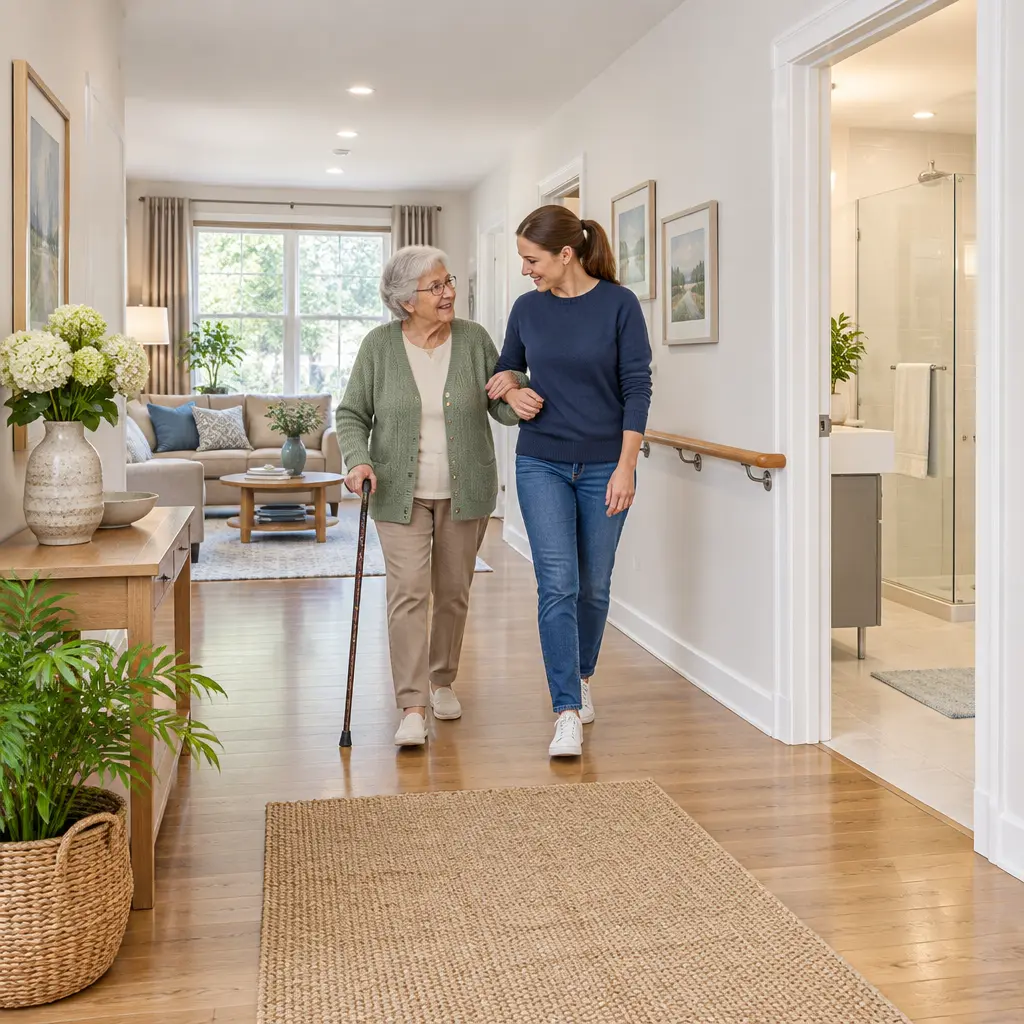
Accessible circulation means being able to enter the home and move between rooms with fewer barriers. Common changes include secure handrails on both sides of stairs, non-slip surfaces, threshold adjustments, ramps where feasible, and uncluttered paths wide enough for a cane, walker, or wheelchair. Because ramps and structural alterations must be designed for safe slope, landing, and load requirements, families should seek qualified advice rather than improvise.
A useful review traces the person’s actual route: from the entrance to the bedroom, bathroom, kitchen, and usual seating area. The review should also account for carrying objects, opening doors, using mobility devices, and moving safely during poor weather or low light.
Bathrooms and fall hazards
Bathroom adaptation reduces the physical demands and risks associated with transfers, wet surfaces, and limited space. Options include securely installed grab bars, a handheld showerhead, a shower seat, non-slip flooring, improved lighting, and an accessible toilet height. Grab bars should be anchored to appropriate structural support; towel bars are not substitutes.
The CDC’s STEADI initiative—Stopping Elderly Accidents, Deaths & Injuries—encourages healthcare professionals to assess fall risk and connect patients with interventions. A bathroom change is most effective when it is part of a broader review that may include balance, medications, footwear, vision, and the person’s ability to transfer safely.
Lighting, storage, and daily-use layouts
Environmental usability improves when frequently used objects are easy to see and reach. Better lighting at entrances, stairways, hallways, and bathrooms can make obstacles more visible. Reorganizing storage to avoid high shelves, deep bending, or carrying heavy items on stairs may also support safer routines. Motion-activated lights can be helpful, but they should be tested for reliable activation and should not create glare or confusing shadows.
Physical Modifications and Assistive Technology
Physical modifications are changes to the building or its fixtures; assistive technology includes devices and systems that help a person perform tasks, communicate, or remain safe. The right mix depends on assessed needs, affordability, maintenance, and the user’s comfort. A low-cost change may be more useful than a complex device if it solves the actual barrier reliably.
Structural and fixture modifications
Structural work can include widening doorways, creating a roll-in shower, installing a stair lift, or adding a ramp. Fixture-level work may involve lever-style door handles, reachable switches, raised toilet seats, or safer shower controls. Such changes can expand access, but contractors should understand accessibility needs and applicable building requirements. Where the home is rented, occupants may need to discuss permission and responsibilities with the landlord.
Mobility aids and personal devices
Mobility aids include canes, walkers, wheelchairs, transfer benches, and lift equipment. A device is safe only when it fits the person and is used correctly. Physical or occupational therapists can help with selection, fitting, transfer technique, and practice in the actual home environment. Poorly fitted equipment or an untrained transfer can create new hazards rather than reduce them.
Monitoring, communication, and emergency response
Technology can support contact and response through medical-alert systems, wearable emergency buttons, medication reminders, door sensors, and video or motion monitoring. These tools differ in what they detect, how they transmit alerts, and whether someone is available to respond. Families should consider privacy, consent, internet or cellular reliability, battery life, false alarms, and a backup plan for power or service outages.
Technology supplements human support; it does not replace hands-on care, clinical judgment, or emergency services. For a person with cognitive impairment, monitoring should be discussed with the individual and relevant caregivers, with attention to dignity, decision-making capacity, and the least intrusive effective option.
Caregiving, Services, and Costs
Home adaptation includes more than construction: it also depends on whether reliable help is available for tasks the person cannot safely do alone. The Administration for Community Living’s Eldercare Locator connects older adults and caregivers with local services, while Area Agencies on Aging can often explain transportation, meal, caregiver-support, and home-modification programs. Eligibility and availability vary by location.
In-home assistance and caregiver capacity
In-home assistance may include personal care, household tasks, skilled nursing, rehabilitation, or respite for family caregivers. The care plan should specify which tasks require help, when help is needed, and who will provide it. Families should also assess caregiver health, work schedules, training, and backup coverage. A physically accessible home cannot compensate for an unmet need for continuous supervision or complex medical care.
Paying for modifications and services
Costs range from inexpensive changes, such as brighter bulbs or removing loose rugs, to substantial expenses for bathroom remodeling or structural access work. Medicare generally does not cover home modifications when they are considered convenience or general home improvements, though certain medically necessary equipment and home health services may be covered under specific rules. Medicaid waiver programs, state and local grants, veterans’ benefits, nonprofit programs, and housing agencies may offer assistance; terms and eligibility differ.
Before paying for work, obtain written estimates, confirm contractor qualifications, clarify permits and warranties, and ask the relevant insurer or public program what documentation is required. A phased plan—addressing urgent hazards first, then larger projects—can make adaptation more manageable.
Planning for changing needs
Aging-related needs may change after illness, injury, or cognitive decline. A flexible plan identifies triggers for reassessment, such as repeated falls, difficulty managing medication, caregiver exhaustion, or inability to complete essential daily activities. It should also document emergency contacts, medication information, preferred hospitals, and the person’s wishes about care and living arrangements.
Putting a Home-Adaptation Plan Into Practice
A practical plan links an identified need to a responsible person, a specific intervention, a funding source, and a date for review. Families can use the following sequence to avoid spending on changes that do not solve the main problem:
- Discuss the older adult’s priorities, routines, and concerns, including which changes feel acceptable.
- Review daily activities and the home environment, ideally with an occupational therapist or other qualified professional when needs are complex.
- Address immediate hazards, such as poor lighting, unstable rugs, blocked pathways, or unsafe transfers.
- Compare longer-term options, including structural work, assistive devices, in-home services, and possible alternative housing.
- Confirm costs, permissions, contractor competence, coverage, and available public or community assistance.
- Test the changes in daily use and reassess after health or caregiving circumstances change.
Consider a common example: an older adult with reduced balance has trouble entering a tub and avoids bathing when alone. A home assessment may lead to a professionally installed grab bar, a shower seat, improved lighting, and training in safe transfers. If the person also has memory impairment or needs assistance throughout the day, the plan may need scheduled caregiving or a different level of support. The example shows why a single modification should not be treated as a complete solution.
A chart accompanying this article could compare adaptation categories by typical purpose, examples, and planning considerations: environmental changes for hazards, structural work for access, devices for mobility or communication, and services for hands-on support. Such a chart should clarify that costs and suitability vary rather than imply that one option works for every household.
Conclusion: Safer Homes, Better-Informed Transitions
Home adaptation combines assessment, physical modifications, assistive technology, and caregiving services to support safe and meaningful living at home. Fall prevention and accessible routes can reduce specific barriers, while professional guidance helps match solutions to the person and dwelling. Funding, caregiver capacity, privacy, and changing health needs must also be part of the plan.
The broader aim is not to delay residential care at any cost. It is to give older adults and families more time, choice, and safety while recognizing when a higher level of care is appropriate. Start with the person’s priorities, arrange a home-safety review, and contact a local Area Agency on Aging or the Eldercare Locator to explore services and funding options.
Sources: U.S. Census Bureau, 2023 National Population Projections, https://www.census.gov/programs-surveys/popproj.html; Centers for Disease Control and Prevention, Older Adult Falls Data, https://www.cdc.gov/falls/data-research/index.html; World Health Organization, Global Age-friendly Cities: A Guide, https://www.who.int/publications/i/item/9789241547307; National Institute on Aging, Aging in Place: Growing Older at Home, https://www.nia.nih.gov/health/aging-place/aging-place-growing-older-home; Centers for Disease Control and Prevention, STEADI—Older Adult Fall Prevention, https://www.cdc.gov/steadi/; Administration for Community Living, Eldercare Locator, https://eldercare.acl.gov/; Medicare, Home Health Services, https://www.medicare.gov/coverage/home-health-services; Administration for Community Living, National Institute on Disability, Independent Living, and Rehabilitation Research, https://acl.gov/about-acl/about-national-institute-disability-independent-living-and-rehabilitation-research